Mastering Digital Health: Inside the XiA Learning Families
As Europe moves towards a more connected healthcare future with the European Health Data Space (EHDS), the need for specialised skills in health data interoperability has never been more urgent. To make seamless, cross-border health data exchange a reality, IT specialists, hospital managers, and healthcare professionals all need targeted, practical training.
To meet this challenge, the Xpanding Innovative Alliance (XiA) has moved away from rigid, one-size-fits-all courses. Instead, we have created a flexible, modular system of learning. Here is a look at how our educational framework is built.
The Building Blocks: Micro-Content and Learning Families
At the core of the XiA Framework are Micro-Content Learning Blocks (MCLBs): small, self-contained learning units focused on a single concept or task. Think of them as Lego bricks of knowledge.
To make these blocks easy to navigate and combine into meaningful courses, we group them into Families of Micro-Content Learning Blocks (FMCLBs). A Family acts as a thematic folder, ensuring that all the blocks inside it share a coherent subject matter and pedagogical consistency.
Driven by Real-World Needs and Competencies
These Families are built around practical competencies: the combination of knowledge, skills, and attitudes that a professional needs to perform tasks effectively in the real world.
The competencies were identified and shaped by evidence gathered directly from the healthcare and IT sectors during the XiA Needs Assessment.
Structured for Growth: Bloom's Taxonomy
The learning outcomes within each Family are structured using educational frameworks such as Miller's Pyramid and Bloom's Taxonomy.
The learning experience is designed to grow in complexity, guiding learners step by step:
- Foundational: acquiring basic factual knowledge.
- Applied: developing a structural understanding of how concepts connect and work together.
- Specialised: gaining the deeper technical understanding required to integrate and perform these skills in practice.
The Three Umbrella Groupings
To help learners find the training that fits their role, the XiA Families are organised into three overarching categories:
- Essentials and Transversals: the shared, fundamental knowledge needed across the digital health ecosystem.
- EHDS and Systems Components: practical modules focusing on specific types of health data and systems prioritised by European regulations.
- Standards and Semantics: technical modules for experts who build, model, and govern health data.
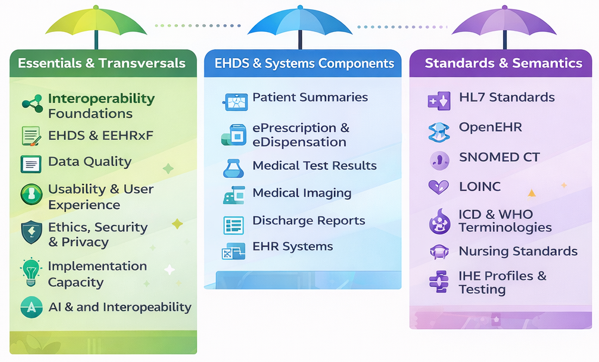
Meet the XiA Learning Families
Essentials and Transversals
These modules lay the groundwork for a shared understanding of digital health across professions.
- Interoperability Foundations: covers the core principles of interoperability, explaining the legal, technical, and organisational layers that allow systems to share data across Europe.
- EHDS and EEHRxF: introduces the European Health Data Space and the European Electronic Health Record Exchange Format, including the distinction between primary and secondary data use.
- Data Quality: explores why clean, complete data is important for safe interoperable services and reliable Artificial Intelligence.
- Usability and User Experience: focuses on patient-centred design and making interoperable systems intuitive and user-friendly for clinicians and information systems specialists.
- Ethics, Security and Privacy: addresses data protection, cybersecurity, and GDPR compliance to support trust in cross-border data exchange.
- Implementation Capacity: addresses the skills needed for digital transformation, including interprofessional communication, change management, and assessing readiness to adopt new technology.
- AI and Interoperability: explains how interoperable data supports Artificial Intelligence at the point of care, focusing on decision support and clinical workflows.
EHDS and Systems Components
These modules focus on the concrete types of medical data and systems involved in European health data exchange.
- Patient Summaries: details the structure and clinical relevance of a Patient Summary, providing essential information about a patient's health for cross-border care.
- ePrescription, eDispensation and eProduct Information: explains the standards and structures for digital prescriptions, electronic leaflets, and the identification of medicinal products (IDMP).
- Medical Test Results: focuses on the secure and accurate exchange of laboratory and other diagnostic findings.
- Medical Imaging: teaches the standards needed to share medical images, such as X-rays or MRIs, and their related reports between health systems.
- Discharge Reports: covers standards for hospital discharge summaries and consultation reports to support continuity of care.
- EHR Systems: provides an overview of Electronic Health Record systems, their architecture, and their role as a source of interoperable data.
Standards and Semantics
Designed particularly for developers and IT implementers, these modules explore the technical languages that allow health systems to exchange and use information.
- HL7 Standards: covers messaging standards and API-based exchanges, including CDA and FHIR.
- openEHR: introduces a complementary approach to building Electronic Health Records, focusing on rich semantic modelling and long-term data storage.
- SNOMED CT: explores the clinical terminology used to represent medical concepts, such as diagnoses and symptoms, consistently across systems.
- LOINC: explores the international standard used to identify laboratory tests and clinical observations.
- ICD and WHO Terminologies: covers World Health Organization classification systems for diseases, interventions, and functioning.
- Nursing Standards: focuses on the specialised classifications and documentation systems used to capture nursing care.
- IHE Profiles and Interoperability Testing: teaches the use of integration profiles and testing platforms, such as Gazelle, to verify that different software systems can exchange data successfully.
By breaking down complex digital health concepts into targeted, needs-based Families, the XiA Framework helps Europe's health workforce acquire the skills needed for the future of healthcare.
Author: Simon Lewerenz